Showing posts with label India Defence News. Show all posts

Tuesday, 24 March 2015

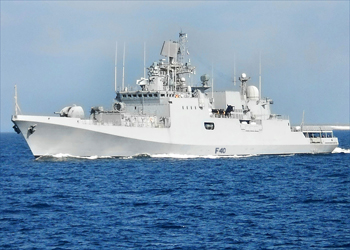
3 Immediate Support Vessels join Navy to protect offshore assets

Flag Officer Commanding-in-Chief Eastern Naval Command Vice Admiral Satish Soni unveiling the plaque of the Immediate Support Vessel IN ISV T 39 after he commissioned the vessel along with two other ISVs at Naval Dockyard in Visakhapatnam on Tuesday - Photo: K.R. Deepak

IN ISV T38, IN ISV T39 and IN ISV T40 – joined the 84th ISV Squadron of the Indian Navy in the Eastern Naval Command. The second batch of the three ISVs was commissioned by Flag Officer Commanding-in-Chief of the Eastern Naval Command Vice Admiral Satish Soni at a ceremony held at the Naval Dockyard here on Tuesday.

With this the Eastern Naval Command has its full complement of six ISVs. The project is a joint collaboration between Oil and Natural Gas Corporation, the ship builders and the Indian Navy.

The ISVs would be based at Visakhapatnam and by turn two ISVs would be patrolling the nation’s assets in Offshore Development Area off Kakinada, Vice Admiral Satish Soni said.

Friday, 20 March 2015

Government explores joint venture in defence production with Thailand

India is exploring a joint production and development venture in defence with Thailand. A high-level defence delegation from Thailand led by its Permanent Secretary for Defence will visit New Delhi next week to explore joint production and development, besides sourcing of arms, diplomatic sources told ET.

The Indian side is keen to assist Thailand in setting up a defence industry and had proposed a visit to Indian facilities for the Thai side. While major platforms and systems will not be discussed now, a start can be made on systems that the ordnance factories manufacture - from explosives to small arms and defensive equipment, sources said.

"Thailand is offering India an upgraded defence relationship. It is a strategically-placed neighbour with whom we share common cultural linkages," an official pointed out. India's joint defence production has so far been confined to Russia, France, the US andIsrael. An upgraded Indo-Thai defence cooperation is also significant amid China's growing ambitions and defence manures in the region, say experts.

The Defence Ministry has been keen on engaging with Thailand. The first initiative was made in 2013 during a visit by then Defence Minister AK Antony in which he raised the matter of joint production with his Thai counterpart, Air Chief Marshal Sukumpol Suwanatat.

This initiative is now getting the push, sources pointed out. Officials said that while detailed discussions to narrow down areas of cooperation will now take place, there has been a keen interest by the Thai side to engage with Indian scientists as well as learning from the experience of setting up defence production facilities.

Till now, the bilateral defence relation has been limited to joint exercises and training between the armed forces. Last year, General Tanasak Patimapragorn, Chief of Defence Forces (CDF) of the Royal Thai Armed Forces visited India.

Tata, Mahindra, Reliance vie for $1.5 billion Naval helicopter order

Several top Indian companies including TATA, Mahindra and Anil Ambani-led Reliance Group are vying for the nearly US $1.5 billion Naval Utility Helicopters Programme under the 'Make in India' initiative. Defence sources said more than eight domestic firms have responded to the 'Request for Information (RFI)' issued by the government in October last year and the Defence Ministry is currently studying them.

The last date for reply to the RFI for over 100 helicopters was February 28, the sources said, adding Indian companies have tied up with foreign firms for the deal which was initially supposed to have gone to international players.

The Modi government had in August last year scrapped the tender and put the acquisition under the 'Buy and Make Indian' category, allowing the Indian industry to make the helicopters under a joint venture with a foreign manufacturer.

RFI responders included Punj Llyod, Bharat Forge, Mahindra Aerospace, Reliance Defence and Aerospace, Tata Advanced Systems and the state-owned Hindustan Aeronautics Limited (HAL), the sources said.

European major Airbus is in talks with several Indian firms including TATA, Mahindra and Reliance. The sources maintained that it was yet to firm up a partnership and that talks were on. Besides Airbus, interested foreign players include Agusta Westland, Bell Helicopters and Sikorsky.

State-run HAL could tie up with the Russians for Kamov 226 helicopters. This helicopter was offered by the Russians during its President Vladamir Putin's visit late last year. The Naval headquarters has invited the interested Indian companies, along with representatives from Original Equipment Manufacturers (OEMs), for presentations starting March 16.

Industry sources said the "main challenge" is to ensure that OEMs have clearly defined partnerships with the Indian companies so that the programme execution meets the DPP (Defence Procurement Procedure) guidelines. "With some of the OEMs still working with multiple Indian partners, there seems to be an urgent requirement for focused approach," an official with a private firm said.

Russia, China may coordinate on nuclear-powered destroyer

Russia is very likely to start construction on the world's third nuclear-powered destroyer with the assistance of China, according to the Sputnik News based in Moscow.

Admiral Igor Kasatonov, retired deputy commander of the Russian Navy, said the construction of the 10,000-ton Leader-class guided-missile destroyer would begin in 2017. Vasily Kashin, a military expert from the Center for Analysis of Strategies and Technologies based in Moscow, said the project provides a new opportunity for China and Russia to deepen defense cooperation.

The Leader-class destroyer would be the world's third nuclear-powered destroyer after the USS Truxtun (DLGN-35) and USS Bainbridge (DLGN-25) of the United States. Since both American vessels were later redesignated cruisers, the Leader-class would in fact be the only nuclear-powered destroyer in the world. Kashin said that the Leader-class is larger than the two American ships.

Unlike the US Navy, Russia does not have overseas naval bases around the world, the piece said, and it makes sense for Russia and China to build nuclear-powered destroyers or cruisers that can remain at sea for longer. Kashin also said China is working hard on the design of a nuclear-powered aircraft carrier. The participation of China in the construction of the Leader-class destroyer may give China the experience it needs, he said.

Thursday, 19 March 2015

Indian Air Force to Use Russian-Indian Missile by 2016

LANGKAWI (Sputnik) — The Indian Air Force plans to start mounting BrahMos cruise missiles on its aircraft in 2016, BrahMos Aerospace CEO Sudhir Mishra told RIA Novosti Wednesday.

The short-range supersonic missile was jointly developed by Russia and India and has been in use by the Indian Navy since 2005.

"The missile is scheduled to be adopted in 2016, ten more tests will be carried out by the end of the year," Mishra said.

He added that the next test flight is due in May with the aircraft carrying the missile launcher. This will be followed by flights with the equipped missiles and, eventually, test firing them.

India is Russia's biggest arms trade partner, with more than 70 percent of India's military equipment coming from Russia or the former Soviet Union, according to Russia's state arms exporter.

The two countries are taking part in the major Langkawi International Maritime and Aerospace Exhibition (LIMA'15), currently underway in Malaysia.

India activates maritime surveillance radar in the Seychelles

Indian Prime Minister Narendra Modi has activated a donated maritime surveillance radar system in the Seychelles and promised to donate another Do 228 surveillance aircraft to the island nation during a visit there last week.

On 11 March Modi launched the Coastal Surveillance Radar station located on a mountainous central region of the main island of Mahé, describing it as another symbol of the cooperation between the two countries, reports the Seychelles News Agency.

In early 2012 India and the Seychelles signed several agreements related to maritime security in the Indian Ocean, including a pact for the supply of a coastal surveillance radar system worth $10 million (140 million rupees), and Dornier surveillance aircraft.

During his visit last week, Modi also announced that a second Dornier surveillance aircraft would be donated to the Seychelles Coast Guard to increase maritime security. The first Dornier Do 228 was given to the Seychelles in early 2013.

“Our security partnership is strong. It has enabled us to fulfil our shared responsibility to advance maritime security in the region,” said Modi. “It is a privilege to be a partner of Seychelles in the development of its security capabilities.”

He added that the radar system is part of a regional surveillance network being installed in several Indian Ocean island states and hoped the Seychelles would become a full partner in the maritime security cooperation arrangement between India, the Maldives and Sri Lanka.

India has had bilateral relations with the Seychelles since it gained independence in 1976, especially in the fields of health, education and defence. In November last year India donated a second 46 metre SDB Mk 5 patrol boat to the Seychelles, the PS Constant, nine years after donating the PS Topaz (formerly INS Tarmugli) in 2005. 

INS Tarasa is an SDB Mk 5 patrol boat built by India's state-owned Garden Reach Shipbuilders & Engineers in Kolkata and refurbished by the Naval Dockyard Mumbai. She has a displacement of 319 tons, a maximum speed of 28 knots and a complement of 24.

The Seychelles Coast Guard fleet further expanded in April 2014 when China donated the 38 metre Etoile patrol boat, built specifically for the Seychelles. The new vessels join the Topaz, Andromache, La Fleche and Le Vigilant (the latter two donated by the UAE). China previously donated two Y-12 aircraft for maritime surveillance.

Indo-France naval exercise ‘Varuna’ to begin next month

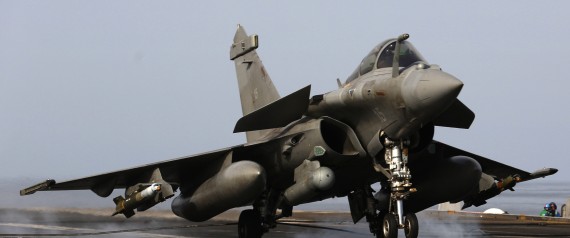
India and France will hold a 10 day naval exercise ‘Varuna’ next month that will see the French aircraft carrier Charles de Gaulle with naval version of Rafale aircraft in action.

The exercise to be held in the Western coast will begin on April 23 and continue till May 3. Defence sources said the French will also bring in two destroyers and one support ship, part of the Charles de Gaulle task force.

India will also deploy its aircraft carrier INS Vikrant along with other ships and aircraft.

The annually held Varuna naval exercise is an integral part of France?India strategic relationship and consists of naval cooperation drills between the French and the Indian Navy.

This year’s exercise will focus on theatre-level Indo-French military cooperation in aero-naval and anti-submarine warfare

Tuesday, 17 March 2015

UAVs, ATVs soon to shore up BSF patrolling power in Rann of Kutch


An array of modern Unmanned Aerial Vehicles (UAVs), fast-attack craft and all- terrain vehicles (ATVs) will soon bolster the dominion power of the BSF deployed to guard the marshy and arid Rann of Kutch region along the Indo-Pak border. 

The country's 'first line of defence' is also planning to station some all-weather floating vessels near the disputed waters in the region including around Sir Creek and Harami Naala areas, a top BSF commander said. 

"The border guarding force is vigorously pursuing to get UAVs and we are very hopeful that very soon we will be able to get these," BSF Inspector General (Gujarat Frontier) Santosh Mehra said. 

Mehra said, as of now, routine sorties by UAVs are being carried out by the Indian Air Force (IAF) on the request made by BSF along the 850-km stretch on the Indo-Pak border. 

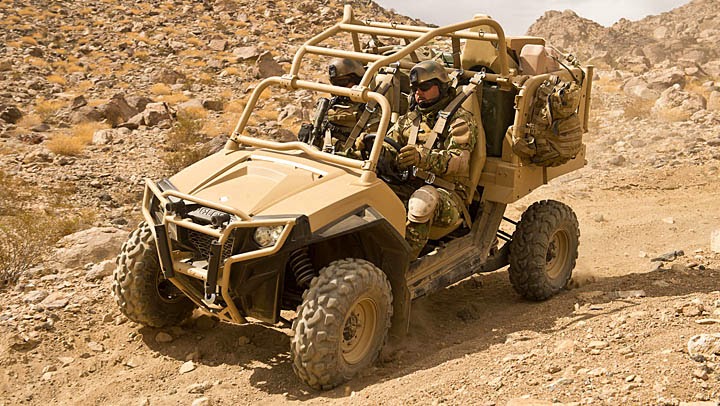
The patrolling in the marshy Kutch region, which is currently being done by foot soldiers and four all-terrain vehicles, will further be enhanced with the induction of more all-terrain vehicles (ATVs), the IG said. 

The demo of the ATVs have been taken and some customisations are being done by the supplier firm as per the suggestions made by the BSF, Mehra said, without disclosing the exact number of procurements to be made. 

"We have projected requirement for getting more ATVs. I would not like to mention the exact number, but a very large number of ATVs will be coming, not only in terms of numbers but varieties also," Mehra said. 

Also in the pipeline are fast-attack craft that the force has been seeking for sometime to facilitate quick action along the vast stretches of the Great Rann. 

"We are also getting fast-attack craft very shortly. A team has recently visited the United States of America. It had been in the pipeline for quite some time but maybe in the next three-four months we will be able to get fast-attack craft that will be able to move at very short notice," Mehra said. 

"Their range is more, they are able to move at faster speed, can carry more number of individuals and they have greater stability," Mehra said, speaking about the capabilities of the soon-to-be-inducted warship.

DRDO hunts for a supersonic Flying Test Bed. Will it be a Sukhoi


If the Defence Research and Development Organisation (DRDO) has its way, an aircraft that can reach supersonic speeds would enter Bengaluru's celebrated list of fighters enjoying permanent residency.

Sources confirm to OneIndia that the DRDO has already moved a paper to acquire a supersonic aircraft that will act as a FTB (Flying Test Bed). The FTB is an aircraft being used for testing the performance of systems and sub-systems in airborne conditions. The systems can range from engines, radars, data links, EW (electronic warfare) suites, radio altimeters among others.

DRDO says the FTB reduces the cycle time for the development of airborne systems. Also, more FTBs under their command could reduce the dependency on foreign agencies. In May 2014, the DRDO had acquired a FTP Nabhrathna -- a modified and custom-made Dornier (DO-228) aircraft, built by Hindustan Aeronautics Limited (HAL). Nabhrathna was rolled out from the hangars of HAL's Kanpur-based Transport Aircraft Division.

Sukhoi is the best bet as FTB ::
A committee has already been set up to look into the possibilities of acquiring the FTB. In addition to members from the DRDO, the committee has representatives from the Indian Air Force and HAL. While Sukhoi is leading the fray, the advantages of MiG 29 are also being considered by the committee.

The current requirement for a supersonic FTB is being explored for the primary use of Gas Turbine and Research Establishment (GTRE). Although GTRE's capabilities in developing a desi power plant for Light Combat Aircraft Tejas have run into a rough patch, efforts are being made to carry forward the technical expertise for other engine programmes.

Sukhoi is being tipped as the best choice with a price tag of around Rs 400 crore. DRDO officials are of the opinion that with HAL's MiG Complex in Nashik already rolling out, they have the advantage of making the modifications with less fuzz. "It's a huge process to make modifications if the aircraft is imported from abroad. We have to save time and money and Sukhoi could be the answer. Even certification too becomes easier in India," an official said.

BrahMos experiments will come handy ::
DRDO officials say that the modification work on Sukhoi done for launching the air version of BrahMos will come handy for DRDO. "The BrahMos missile weighs around 2.5 tonnes while a Kaveri engine is around 1.22 tonnes. There are two pilots in a Su-30 MKI and one can easily monitor the engine and independently operate it," the official said.

With the wind tunnel test results of BrahMos already available, DRDO is hopeful that a decision is taken soon in acquiring the FTB. "Our labs including LRDE, CABS, RCI and other national institutes such as IISC and NAL too will require a supersonic FTB," the official added.

Once DRDO acquires a supersonic FTB, it will be flown by Test Pilots from the Aircraft Systems Testing Establishment of IAF in Bengaluru. Currently, the DRDO operates a low speed FTB (IL-76) suitably modified to carry out Kaveri engine tests at Gromov Flight Research Institute (GFRI) in Moscow. 

"We felt the need for a high speed FTB capable of high manoeuvres for assessing the engine behaviour during transients. The feasibility of using MiG-29 available at GFRI Moscow is being studied now. We have already assessed the modifications to be carried out on the MiG-29," the official said.

India remains world's largest arms importer


NEW DELHI: India continues with its embarrassing trudge on the world stage as the largest arms importer, which also makes it strategically vulnerable. A global thinktank on Monday said India's weapons imports are now three times larger than its neighbours China and Pakistan as well as cash-rich Saudi Arabia and the UAE.

The latest data on international arms transfers released by Stockholm International Peace Research Institute (SIPRI) shows India accounted for 15% of the global arms imports from 2010 to 2014. "Between 2005-2009 and 2010-2014, India's arms imports increased by 140%. In 2005-2009, India's imports were 23% below China's and just over double those of Pakistan," SIPRI said.

There is nothing new in India's dubious distinction of being the largest arms importer due to its abject failure to build a strong defence industrial base (DIB), as repeatedly reported by TOI earlier. But the figures do show how China has got its act together to assiduously build a stronger DIB, often by reverse-engineering, to also emerge as the third largest arms exporter. While Pakistan (41%), Bangladesh (16%) and Myanmar (12%) are its three biggest clients, China also exported arms to 18 African countries.

In sharp contrast, India continues to grapple with a fledgling DIB, importing 65% of its military hardware and software. India has spent Rs 1,03,536 crore ($16.72 billion) in direct payments to foreign armament companies in the last five years, while exporting arms worth a paltry Rs 2,644 crore ($426 million) in the same time.

Military supplies and infrastructure-building are key to China's expanding strategic footprint in both India's immediate neighbourhood as well as in Africa. India, however, cannot even equip its own armed forces properly, leave alone use military aid to influence others.

India has spent over $120 billion on arms acquisitions over the last 15 years, and will spend another estimated $120 billion in the coming decade, as reported by TOI earlier. Despite the Modi government's tom-tomming of the 'Make in India' policy over the last 10 months, there is little to show on the ground in terms of concrete action till now.

The SIPRI figures show India is the largest arms client for both Russia and Israel. The three largest suppliers to India are Russia (70%), the US (12%) and Israel (7%). But government figures show the US has actually overtaken Russia as the largest defence supplier in the last three years, notching sales worth Rs 32,615 crore as compared to Russia's Rs 25,448 crore.

Friday, 13 March 2015

UK to Offer Eurofighters Should India Scrap Rafale Deal

The United British authorities are aware that the “deal with Dassault has not gone smoothly,” Hammond said, adding that the United Kingdom sees this as an opportunity to offer Eurofighters if India opens an official competitive bidding.

Kingdom is ready to offer Eurofighter aircraft if India’s long-disputed deal to acquire French Rafale jets falls through, UK Foreign Secretary Philip Hammond said Thursday.

Hammond, who is currently on a two-day trip to India, noted that he had not raised the issue with Indian authorities in the course of the ongoing meetings. In 2012, India chose France’s Dassault Aviation to supply  it with 126 Rafale fighter jets, scrapping a rival proposal from the producers of the Eurofighter Typhoon.

However, the project has been put on hold over high costs and Dassault’s unwillingness to guarantee the performance of Rafale aircraft produced in India under transfer of technology agreements.
 
The Eurofighter Typhoon is a multirole fighter aircraft jointly produced by three companies based in United Kingdom, Germany and Spain, and Italy.

Indian media has suggested that countries authorities can abandon the Rafale Deal in favour of Russia designed SU-30 fighters.

Tuesday, 10 March 2015

Indian Navy inclined towards three more improved Talwar-class frigates

The Indian Navy, which has been offered three or four more ‘highly improved’ Talwar-class frigates by Russia, has indicated that it may be inclined to take up the offer. Oleg Shumakov, acting General Director and chief executive of the Yantar Shipyard has told Russian journalists that the Indian Navy has expressed interest in taking forward discussions on the offer.

No specifics have emerged so far on precisely what the upgraded elements on the offered vessels will be, though they are likely to be in the integrated combat management system, air defence weapons and secondary sensors. The Indian Navy operates six Talwar-class frigates, delivered between 2003-2013. Like the second batch of the class delivered to the Indian Navy, the offered vessels will also sport the BrahMos missile system.

Negotiations are also currently on for a contract to upgrade the first three Talwar-class frigates with a new combat management and data system as well as new generation weapon systems. The Indian Navy currently in the process of building Project 17A stealth frigates of its own, has a specified need for more frontline combatants to support its blue water aspirations.

India will set up 32 surveillance stations in Mauritius, Seychelles, Maldives and Sri Lanka

India will set up 32 surveillance stations fitted with navigational military radars in Mauritius, Seychelles, Maldives and Sri Lanka to keep an eye on the Chinese maritime traffic in the Indian Ocean region. On Wednesday, Prime Minister Narendra Modi is leaving for a five-day tour of the island nations, during which he would commission the first coastal surveillance radar system in the Mahe island in Seychelles.

The remaining seven stations in Seychelles would be up and running in the next six months. Five of them would be at Mahe whereas three would be located in outer islands.

While the prime minister was initially scheduled to visit all the four islands housing these coastal radars, Maldives was dropped out of his itinerary because of the ongoing political turmoil.

The India Ocean surveillance radar network comprises eight stations each in Seychelles and Mauritius and 10 in Maldives. Former defence minister A K Antony commissioned the snooping stations in Mauritius about two years ago.

The six units in Sri Lanka, however, do not have the radar at the moment but only the automatic identification system (AIS) and electro-optical instruments. Other islands would have all the three components – maritime navigational radar that operate in the I-band frequency, AIS for boats weighing more than 300 tonnes and the electro-optical system for imaging.

While the network would aid these islands to monitor their Exclusive Economic Zone, India can use the data to keep an eye on the Chinese maritime traffic.

“We have to do it for our own interest. Else, someone else (read China) will gain in the time we lose,” said a source.

The 10 coastal radar stations in Maldives are soon expected to receive the Cabinet approval. Navy chief Admiral R K Dhowan visited Mauritius in January when he reviewed the progress of several naval projects, including the coastal stations.

HAL Light Utility Helicopter first flight in August

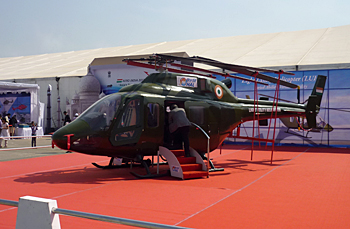
HAL’s Light Utility Helicopter is all set to undertake its first flight from the HAL Airport in Bengaluru in August this year. A mock-up displayed at last month’s Aero India show in Bengaluru has attracted interest from several countries, with delegations at the show requesting to be kept updated on progress of the platform to support future requirements in those countries.

HAL’s LUH project director K. Mahabaleshwara Bhat was a busy man at the show, hosting several interested military delegations inside the cabin of the olive green liveried LUH mock-up in the central forecourt of the show’s display area. The LUH is being developed keeping in mind several key lessons learned on the Dhruv programme. The LUH, being developed with skids undercarriage will also be spun off in a wheels version.

It is also being developed with foldable rotors (the entire operation takes 10 minutes to complete) — a key lesson learnt on the Dhruv programme, to make it acceptable to the Indian Navy for shipborne roles. Future builds of the Dhruv, incidentally, will sport the foldable rotor system perfected on the LUH and offered afresh to the Indian Navy. The Dhruv currently only functions from shore. The LUH is being developed to meet a requirement of 187 helicopters (the remaining 197 will be through the new Make in India RSH programme).

India to invest $25 billion in FGFA project

India is ready to seal a big project with Russia for the stealth fifth-generation fighter aircraft (FGFA), The Times of India wrote referring to the country’s defense ministry.

“Faced with continuing deadlock in the mega deal to acquire 126 French Rafale fighters, India is now pressing the throttle to seal the even bigger project with Russia for the stealth fifth-generation fighter aircraft (FGFA),” the newspaper wrote.

“India will overall spend around $25 billion on the FGFA project if it goes ahead with its plan to induct 127 such fighters, as earlier reported by TOI.

Meanwhile, India is ready to forego the earlier plan for a 50:50 design and work-share agreement with Russia on its under-development FGFA called PAK-FA or Sukhoi T-50.”

The PAK FA – “Prospective Airborne Complex of Frontline Aviation” – is a fifth-generation fighter program of the Russian Air Force. The T-50 is the aircraft designed by Sukhoi for the PAK FA program. The aircraft is a single-seat, twin-engine jet fighter, and will be the first operational aircraft in Russian service to use stealth technology. It is a multirole combat aircraft designed for the air superiority and ground attack functions. It combines supercruise, stealth, manoeuvrability, and advanced avionics to overcome previous generation fighter aircraft along with many ground and maritime defences.

The PAK FA is intended to be the successor to the MiG-29 and Su-27 in the Russian Air Force and serve as the basis for the Fifth Generation Fighter Aircraft (FGFA) being co-developed by Sukhoi and Hindustan Aeronautics Limited (HAL) for the Indian Air Force. The T-50 prototype first flew on 29 January 2010 and production aircraft is slated for delivery to the Russian Air Force starting in 2016. The prototypes and initial production batch will be delivered with a highly upgraded variant of the AL-31F used by the Su-27 family as interim engines while a new clean-sheet design powerplant is currently under development. The aircraft is expected to have a service life of up to 35 years.

Russia to partner in AMCA Technologies

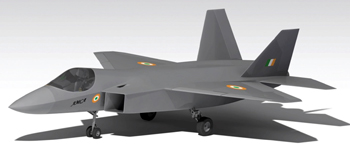
India has approached Russia to partner it on certain critical technologies for the Advanced Medium Combat Aircraft (AMCA). Top sources tell SP’s that the Aeronautical Development Agency (ADA) has asked Russia for assistance in developing thrust vectoring and certain other technologies on the concept fifth generation jet platform. There has been steady progress in the programme following the basic design freeze.

The ADA has opened discussions with turbofan houses in the US, Russia and Europe for what it believes need to be 110 kN engines in twin configuration for the AMCA. The engines will specifically need to support supercruise. The ADA has indicated to engine manufacturers that modifications could potentially be a joint effort in country, involving the DRDO and other agencies if necessary.

Either way, the ADA has ambitiously aimed at producing up to four prototypes, with the first rolling out in 2019. As the ADA recently set down as the aircraft’s profile and definition, “The AMCA is being designed as a stealth, medium weight, twin engine, multimission aircraft with a swing-role capability.

Among the advanced technologies that confer stealth capabilities are serpentine air intakes, internal weapons bays, radar absorbing structure (RAS), radar absorbing materials (RAM), frequency selective surface radome and conformal air data probes. The avionics system features integrated modular architecture supporting NCW capabilities, advanced pilot-vehicle interface, pilot associate and integrated vehicle health management. The integrated flight and propulsion control system will combine the traditional flight control functions with thrust vectoring and engine control functions.”

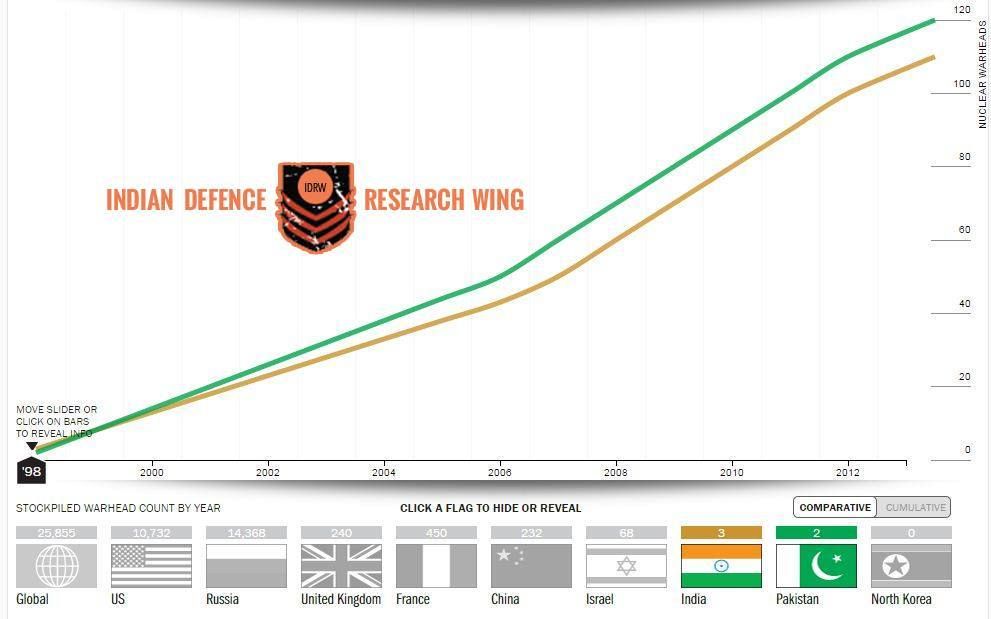
Pakistan has more nukes than India, shows new infographic

Pakistan had about 120 atomic weapons, 10 more than India, in its nuclear arsenal last year, according to a new interactive infographic unveiled by the Bulletin of the Atomic Scientists.

Designed by the Bulletin, founded in 1945 by University of Chicago scientists who had helped develop the first atomic weapons in the Manhattan Project, the infographic tracks the number and history of nuclear weapons in the nine nuclear weapon states.

The Nuclear Notebook Interactive Infographic provides a visual representation of the Bulletin’s famed Nuclear Notebook, which since 1987 has tracked the number and type of the world’s nuclear arsenals.

Having reached a peak of over 65,000 in the late 1980s, the number of nuclear warheads has dropped significantly to a little over 10,000, but more countries now possess them, it shows.

According to the infographic, the United States and Russia both have about 5,000 weapons each.

France has 300, China 250, the United Kingdom 225 and Israel 80. North Korea has only conducted nuclear tests in 2006, 2009 and 2013.

“I don’t think people truly understand just how many of these weapons there are in the world,” said Rachel Bronson, executive director of the Bulletin.

“The Interactive is a way to see, immediately, who has nuclear weapons and when they got them, and how those numbers relate to each other. It is a startling experience, looking at those comparisons.”

The authors of the Nuclear Notebook are Hans M. Kristensen and Robert S. Norris, both with the Federation of American Scientists.

In the most recent edition of the Nuclear Notebook, the authors discuss the Notebook’s 28 year history and describe how sometimes host countries learned of foreign nuclear weapons on their soil from the Nuclear Notebook.

Over 28 years of weapons analysis, the Nuclear Notebook column has revealed surprise nuclear activity and spot-on arsenal estimates while becoming a daily resource for scholars, activists and journalists.

“We wanted a way to communicate those numbers visually, because the world we live may be data-driven, it’s also visual,” said John Mecklin, editor of the Bulletin.

“The new infographic makes this vital information even more accessible.”

Monday, 9 March 2015

Govt shortlists L&T, Pipavav for Rs 6,000 cr submarine contract


The government has shortlisted Larsen & Toubro (L&T) and Pipavav Defence & Offshore Engineering Company, in which the Anil Ambani group firm Reliance Infrastructure has recently acquired management control, for award of a Rs 60,000-crore contract to build six conventional submarines under its Project 75i.

According to highly-placed sources, a high-level committee headed by vice-admiral Subhedar, which had inspected both public and private shipyards to shortlist candidates to issue the request for qualification (RFQ) for Project 75i, in its final presentation to the ministry of defence (MoD) last week, selected the two private sector shipyards — L&T’s Katupalli yard and Pipavav unit.

The tender, the sources said, would be a ‘buy and make (in India)’ one, which implies tie-ups for technology with foreign collaborators with substantial manufacturing in India.

Pipavav Shipyard has entered into some agreements recently with some global majors with a view to diversify into the submarine market and also has the capacity to build many boats simultaneously.

At a Defence Acquisition Council meeting last year, the MoD was directed to set up a committee to identify shipyards in India capable of building submarines.

The committee, with representatives from the Navy and MoD, conducted a survey of shipyards along both the coasts, including Garden Reach Ship-Builders, Hindustan Shipyard, Goa Shipyard, L&T, Mazgaon Docks, ABG Shipyard and Pipavav Shipyard.

According to the government’s decision all six submarines will be built in India on the lines of the predecessor P75 Scorpene production line at MDL, Mumbai. Bids were invited from Indian shipyards to build the six submarines using transferred technology from a foreign partner.

Project 75i is designed to purchase 6 next generation diesel submarines with Air Independent Propulsion System (AIP) technology for Indian Navy by 2022. While conventional diesel-electric submarines have to surface every few days to get oxygen to recharge their batteries, AIP systems will help the submarines to stay submerged for longer periods. Apart from AIP, the new submarines will have advanced detection range and combat management systems and better sensors for optimum performance. The weapon system would be a mix of torpedoes and missiles.

Among the potential foreign submarine contenders in the race for Project 75i are French DCNS ‘Scorpene’, Russia’s Rubin Amur 1650, the German HDW Type 214, Spain’s Navantia S-80 which broke its partnership with DCNS a while ago has been offering the S-80 design with an ethanol based AIP supplied by Abengoa.

Navantia also has a tie-up with Lockheed Martin for combat management systems and on India, it is known to have been working closely with L&T albeit on surface ship projects. The Swedish Kockums Archer-class is also in the race. 
Interestingly, DCNS of France, already has a technology tie-up with Pipavav Defence. Sembcorp Marine (Singapore), part of Temasek of the Singapore government and a leading global marine engineering group, has a strategic and equity partnership with Pipavav Defence.

For Reliance Infrastructure, which will spend Rs 819 crore for an 18% stake in Pipavav Defence and is slated to acquire an additional stake from the latter’s promoters to increase the shareholding to above 25%, winning Project 75i will be crucial step in getting into defence manufacturing, an integral part of Narendra Modi government’s Make in India campaign.

As per sources, in addition to the leased Russian nuclear-propelled submarine (INS Chakra) and the indigenously built Arihant, India’s navy currently has 13 aging diesel-electric submarines, only half of which are operational at any given time due to refits. Last year, a submarine sank after explosions and a fire while docked in Mumbai.

The delays in the `Scorpene’ (project 75) at Mazgaon Dock Limited (Mumbai) which was intended to induct the vessels at the rate on one ship per year since 2012 has left the Submarine force well below requisite levels. further, previously planned induction of 05 midget submarines and also the fresh impetus on the strategic submarine program constitute a work-load that is far beyond the capacity of existing public sector shipyards.

The six new submarines in P-75 I project will outline various critical parameters including the weight and design of the submarine. The Project 75I submarines are expected to be bigger than the 1800-ton Scorpene class being built for P-75 project. The AIP systems will enable greater underwater endurance and land-attack missiles. Besides, they will also incorporate stealth, land-attack capability and other technological advancements.

While indigenous sources can provide most sub-systems, packing all this together in a hull form that achieves contemporary quietening standards will require foreign collaboration for the selected yards.

Air Devils Of Aero India 2015

The recently concluded 5-day Aero India 2015 in Bangalore (18-22 Feb 2015) was a visual delight for the visitors. The key reason for the show was defence-related business deals; but from visitors' point of view, the impressive fly pasts and the stunning aerobatics displays put up by various global teams was the high point. Here are glimpses of their awesomeness!


HAL Tejas: Its roar shook the airfield!

Sukhoi Su-30 MKI: Breezed through flying upside down.
Despite supersonic speed, Sukhoi Su-30 MKI has a capability to land on shorter runways, thanks to a pair of parachutes opening when it lands.


C-17 Globemaster, a US Air Force Military Transport Aircraft, was the largest monster on display. This 53m long aircraft needs an airstrip of just 900mts to land, and can carry 77.5 tons of cargo.


Cheetah - HAL's Advanced Light Helicopter - demonstrated great manoeuvrability.


Sarang Aerobatics team (in HAL's Advanced Light Helicopter Dhruv) took our breath away with their fearless aerobatics. They crisscrossed each other just a few feet apart and flew one on top of the other, while the audience' hearts were in their mouths as their rotors seemed to be meshing into each other like gears.

India Pushing Russia For Faster Development For Stealth Aircraft As Rafale Deal Stuck

Faced with delays over its biggest airforce deal, a worried Indian government has asked Russia to expedite production of the planned fifth-generation fighter aircraft and given up its earlier condition that it should be a 50-50 joint venture, a report says.

The deal for buying 126 Rafale fighter aircraft from France’s Dassault has been delayed over negotiations over the $11 billion price tag and guarantees over quality. This has delayed India’s plans to expand its airforce at a time it is underprepared.

The government has asked Russia to speed up the development process of the fifth-generation fighter aircraft, Su-35S, and has agreed to drop some crucial conditions in return. For instance, India is no longer insisting that all aircraft be built by state-owned Hindustan Aeronautics. According to a source quoted in the report, India has agreed to the existing practice of importing the initial lot of the fighter aircrafts and manufacturing the rest here under technology transfer programme. In return, India wants the first models to start arriving in 36 months, instead of the earlier eight years.

Prime Minister Narendra Modi has been pushing for higher manufacturing in India under the ‘Make in India’ initiative, and this move would go contrary to that. Given that the airforce wants to upgrade its squadrons urgently, this is not a surprising move. But the new timeframe that the report quotes is ambitious, given that the technology is the most complex in defence aviation.

Fifth-generation aircrafts have stealth, or the ability to avoid being detected by radars. Currently, the United States is the only country to possess such a combat aircraft, the F-35 joint strike fighter.

The Indian airforce has been struggling to build enough airforce squadrons to counter dual threats from China and Pakistan. India requires at least 45 squadrons to repel a joint attack by both countries but has only 25 active squadrons. 14 of those have old jets that are set to be taken out of service this year. The Rafale deal involves sale of 126 fighter fighter aircraft to help bridge the shortfall.

The airforce cannot afford to cancel the Rafale deal and go back to square one. “The air force can’t go through the process of selecting another aircraft,” said Manmohan Bahadur, a distinguished fellow at the New Delhi-based Centre for Air Power Studies and a retired air vice marshal. “That would delay induction plans.”

Nor can the Rafale be replaced with the Russian combat aircraft because the airforce needs both. “MMRCA and Sukhoi-30, the requirements are slightly different. And they have their own capabilities. They complement each other but do not replace each other,” said Arup Raha, Air Chief Marshal, in this interview. MMRCA (Medium Multi-Role Combat Aircraft) refers to Rafale. Sukhoi-30 is the fifth generation aircraft that Russia is building.

Indian Prime Minister Narendra Modi is due to visit Paris in April, where this deal could come up for discussion. This was also one of the main points of discussionduring French Defence Minister Jean-Yves Drian’s recent visit to India and meetings with his Indian counterpart Manohar Parrikar. But a clear timeline could not be established.

While Pakistan’s airforce is still smaller than India’s, China has raced ahead. It has built the world’s third-largest airforce with about 1,900 fighter aircraft including its indigenously-developed J-31 fifth generation stealth model, which was unveiled last